


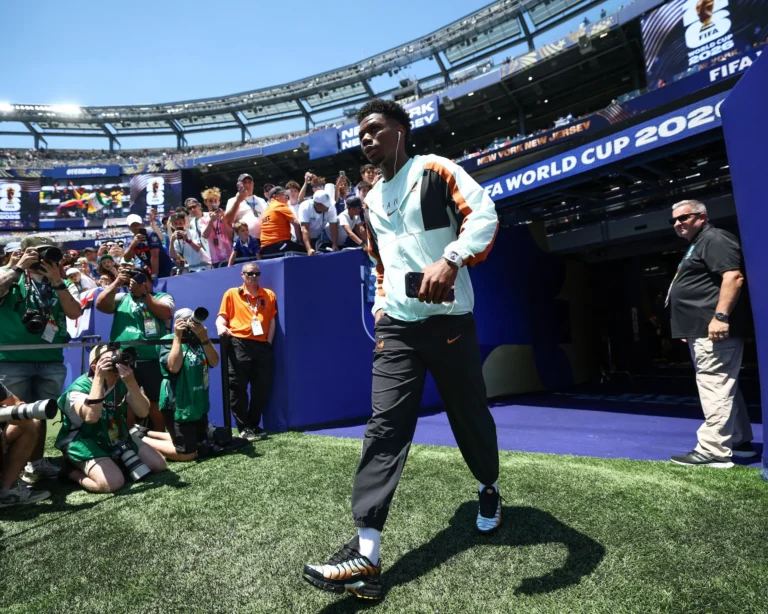
Gary Stover observes that, “France look better to me than PSG.” This sentiment resonates, particularly with the inclusion of Mbappé, but the combination with Kvaratskhelia seems more appealing to some. The thought of sacrificing Neves and Vitinha for Mbappé’s addition does not sit well; however, should it all align, it could spell trouble for the competition.
Matt Burtz expresses surprise at Idrissa Gueye’s inclusion in the starting lineup for Senegal, noting that he is the team’s oldest member by two years. While he is also the most experienced player, his recent performances for Everton have not been stellar. Gueye’s fatigue from participating in the Africa Cup of Nations has compounded his challenges.
Amad Diallo and Bryan Mbeumo also faced difficulties upon returning from Morocco, yet it seems Gueye’s age contributes to his selection rather than detracting from it. It wouldn’t be unexpected to see Sarr make an appearance against Norway and Iran, but Pape Thiaw likely values Gueye’s experience and positional awareness against a formidable offensive threat.
Team Lineups and Strategy
In midfield, Senegal opts for Idrissa Gueye and Papa Gueye over Pape Matar Sarr, which raises eyebrows given Sarr’s athleticism. Iliman Ndiaye finds himself on the bench, aware that Mané and Sarr are firmly established as the starting wide attackers.
For France, the lineup is largely as anticipated, with Desiré Doué taking the right-wing position over Marcos Thuram, a decision that is justified by Doué’s superior skills and work ethic. Ousmane Dembélé, who is still working to connect with Kylian Mbappé, plays behind him. There’s speculation that Rayan Cherki might take that spot later in the tournament, but for now, the choice favors a player who is harder to overlook.
France (4-2-3-1):Maignan; Hernandez T, Saliba, Upamecano, Kounde; Rabiot, Tchouameni; Olise, Dembele, Doué; Mbappe.Subs:Akliouche, Barcola, Cherki, Digne, Gusto, Hernandez L, Kanté, Konaté, Koné, Lacroix, Mateta, Risser, Samba, Thuram, Zaïre-Emery.
Senegal (4-2-3-1):Mendy É; Diatta, Niakhaté, Koulibaly, Diouf E; Gueye P, Gueye I, Camara; Sarr, Jackson, Mané.Subs:Ciss, Diao, Diaw, Dieng, Diouf Y, Jakobs, Mbaye, Mendy A, Ndiaye I, Ndiaye C, Sarr M, Sarr P, Seck.
Referee:Alireza Faghani (Australia)
Historical Context and Significance
The match between France and Senegal carries significant historical weight, representing a mix of nostalgia and cultural ties. Othmane Sonoko, former prime minister and speaker of the Senegalese parliament, believes that, “I must say that I’m a bit surprised to see Idrissa Gueye starting for Senegal, seeing as he’s the oldest member of the team by two years,” adding, “He’s of course also the most capped member of the team, so perhaps experience entered into the equation. His performances for Everton flagged as bit as the season came to a conclusion and it wasn’t because Everton played an excessive number of games, though Gueye’s Afcon participation added to his personal log.”
The two nations previously faced off in the 2002 World Cup opener, a match marked by El-Hadji Diouf’s outstanding performance and Papa Bouba Diop’s memorable goal that led to a stunning upset. France experienced an early exit that year, finishing last in their group with a mere point and failing to score a single goal, marking the worst showing ever by a defending champion. Since then, the teams have not crossed paths again.
As Sonoko suggests, their histories remain intertwined. France began colonizing Senegal in 1659, and it wasn’t until 1960 that Senegal regained its independence. Remarkably, just under a year ago, France relinquished its final military bases in the country. Notably, France boasts the highest number of World Cup players born within its borders, totaling 98 out of 1248, while the Netherlands and England follow with 67 and 49, respectively; ten of those players represent Senegal.
Player Insights
Senegal’s squad is notable for its defensive solidity and intriguing forward options. Lamine Camara stands out as a dynamic midfielder with a blend of traditional and modern elements, showcasing exceptional speed and versatility that is sure to attract Premier League interest. Pape Matar Sarr is already making waves in the league, and there are other talented candidates to complete the midfield trio, including the promising 18-year-old Bara Sapoko Ndiaye from Bayern Munich, who may play a reserve role but possesses significant potential.
In the attacking front, Sadio Mané and Ismaïla Sarr are expected to flank Nicolas Jackson, with Iliman Ndiaye and Ibrahim Mbaye poised to make impactful contributions from the bench. The anticipation for their performance is palpable.
Reflecting on the game’s historical context, the evolution of football laws in 1863 serves as a reminder of the sport’s rich history. Francis Maule Campbell of Blackheath Football Club once asserted, “I think Senegal will win,” His words still resonate, especially as the current squad is more than capable of holding their ground in physical encounters.
The 2026 tournament features a remarkable lineup of attackers, and it remains to be seen whether Didier Deschamps can find the ideal combination to allow them to flourish. The unpredictable nature of the tournament means that every match could yield unexpected brilliance and memorable moments.
As the tournament progresses, one thing has become clear: the excitement surrounding this match is palpable. The upcoming clash promises to be one of the standout fixtures in the group stage, providing a valuable insight into the capabilities of these two thrilling teams. Chouette! On y va!
Kick-off:3pm local, 8pm BST, 5am AEST