


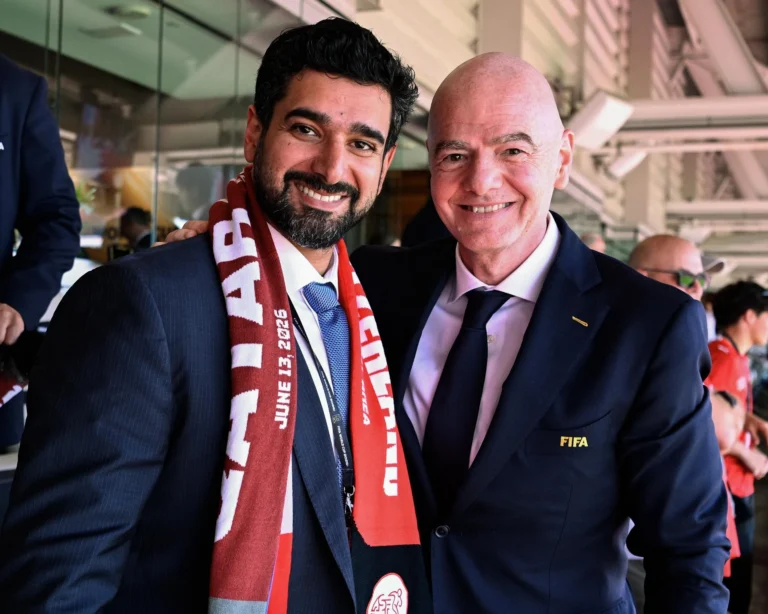
Gianni Infantino, the president of FIFA, has set his sights on attending two World Cup matches each day whenever feasible throughout the tournament, despite the significant travel distances involved.
Infantino is utilizing a private jet provided by Qatar Airways, which is part of the sponsorship agreement with FIFA. This arrangement will facilitate his travel across the United States, Canada, and Mexico during the event.
After witnessing the tournament’s opening match in Mexico City last Thursday, Infantino swiftly proceeded to Guadalajara for South Korea’s victory over Czechia. The following day, he was present in Los Angeles to watch the USA secure a 4-1 win against Paraguay, and he later attended games in San Francisco and Vancouver on Saturday, featuring matches between Qatar and Switzerland, as well as Australia and Turkey.
On Sunday, Infantino did not attend any matches as he was in Miami, hosting a FIFA summit with representatives from all 211 member associations. He returned to Los Angeles that evening to catch Iran’s first match of the tournament against New Zealand.
FIFA sources have confirmed that Infantino intends to watch two matches each day as frequently as possible, despite the demanding schedule. The 56-year-old managed to attend all 64 matches during the 2022 World Cup in Qatar, where the longest distance between stadiums was merely 46 miles.
Travel Challenges of the Current Tournament
The ongoing World Cup spans four time zones and three different countries, with its 16 stadiums located up to 2,800 miles apart. Infantino’s travel will exceed that of anyone else involved in the tournament.
Among the teams, Bosnia and Herzegovina face the most challenging travel schedule in the group stage, covering 3,144 miles from Toronto to Los Angeles, then to Seattle, while also returning to their training camp in Salt Lake City between games.
Environmental Concerns
The extensive travel associated with this World Cup has led the New Weather Institute to label it as “the most polluting event ever” estimating that it will generate approximately 9 million tons of carbon dioxide equivalent. Air travel alone is attributed to around 7.7 million tons of this carbon estimate, significantly exceeding the average emissions for World Cups held from 2010 to 2022.