



Fifa’s association with aggressive American capitalism appears to have hit a wall in Miami, a city renowned for its entertainment scene. Despite just a handful of tickets listed as available on their official platform at the match’s start, numerous empty seats were evident throughout the game, which ended in a hard-fought draw and left Group H evenly matched after Cape Verde’s remarkable tie with Spain earlier in the day.
Gianni Infantino has often described the World Cup as equivalent to 104 Super Bowls, but judging by the crowd turnout, locals might need more persuasion. The official attendance was reported as 62,764 against a capacity of 64,478, yet many fans arrived only in the second half, with Fifa sources attributing the delays to a highway accident.
Miami boasts a higher concentration of Instagram influencers per capita than both Los Angeles and New York, indicating that perhaps Fifa should have enlisted some of these influencers to boost ticket sales instead of relying on the omnipresent IShowSpeed, whose exuberance has started to wear on some high-profile attendees in Fifa’s exclusive areas.
With its foundation in celebrity culture, Miami residents are not easily swayed, and even sports enthusiasts have a plethora of options. The Hard Rock Stadium, which has hosted six Super Bowls and regularly features on the Formula One calendar, was unlikely to attract a fervent crowd for a World Cup match between two teams struggling to score.
The array of empty seats highlighted the potential downsides of Fifa’s dependence on the secondary ticket market in the U.S., as it is clear the tickets were purchased. Given that the face values of category one and two tickets were priced at $430 and $600 respectively, it seems improbable that there were thousands of intentional no-shows. A more likely scenario is that tickets bought by speculative buyers went unsold.
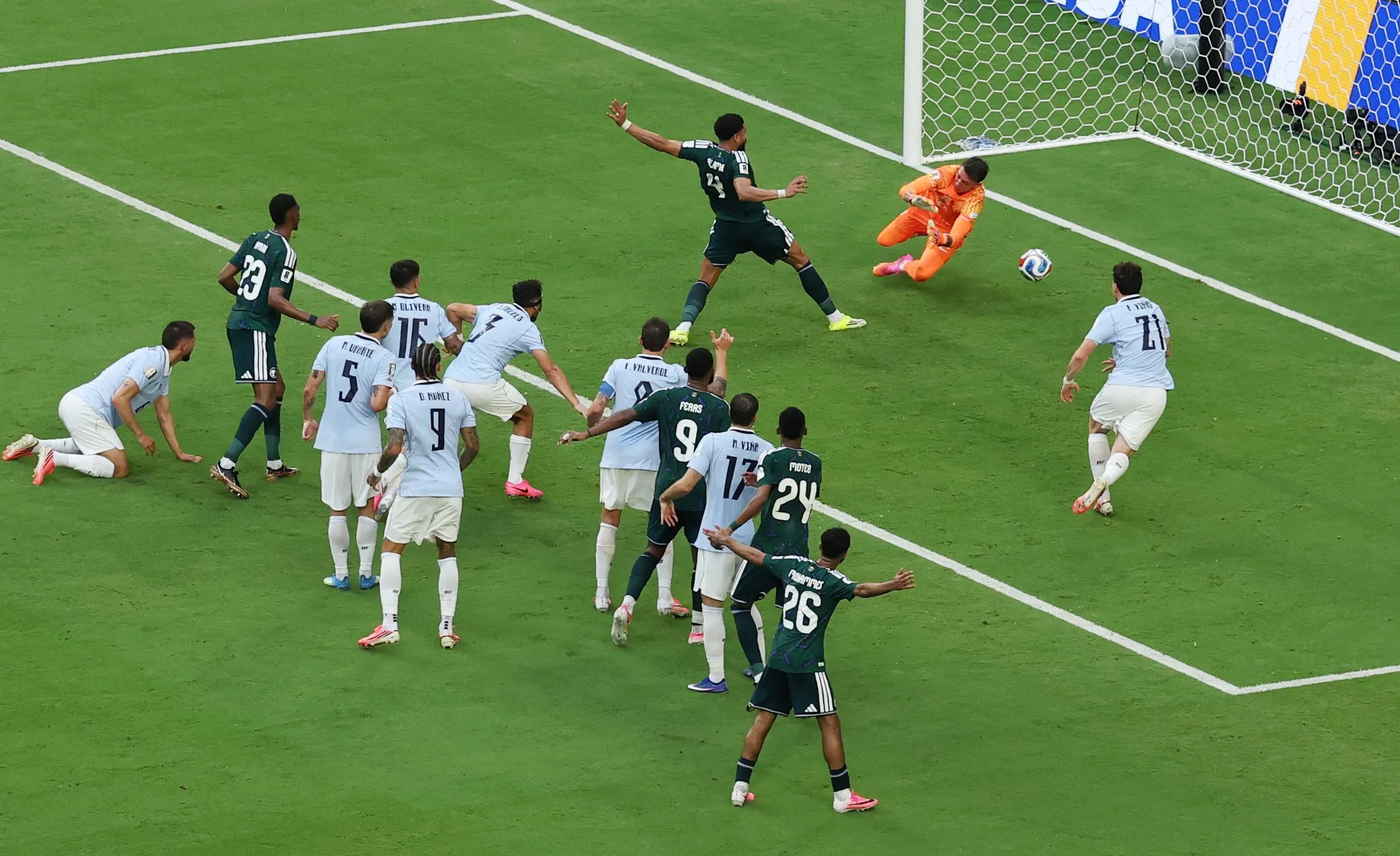
Uruguay’s determination earned them a deserved point after rallying from behind, dominating most of the match until the final ten minutes of the first half when Abdulelah al-Amri scored for Saudi Arabia against the run of play.
Uruguay’s preparations faced disruption due to delays in their flight from Cancún to Fort Lauderdale, exemplifying the challenges of hosting a multi-nation World Cup. However, their travel woes did not seem to have a lasting impact on their performance.
True to the style associated with Marcelo Bielsa, Uruguay commanded possession right from the start, generating a promising opportunity in the fifth minute when Federico Vinas’s cross was met by Ronald Araújo, whose shot was thwarted by goalkeeper Mohammed al-Owais.
A penalty appeal arose in the 20th minute when Sebastián Cáceres’s shot hit the hand of Hassan al-Tambakti, but his arm was clearly positioned at his side. The best chance of the first half fell to Vinas, whose low diving header was directly saved by Owais.
Supported by a vocal group of fans clad in green, Saudi Arabia remained competitive and earned their reward just before the halftime whistle.
Amri had already forced a brilliant save from Fernando Muslera with a powerful header from a corner in the 38th minute before putting his team ahead from another set-piece three minutes later. Musab al-Juwayr’s cross was headed by Tambakti, which Muslera managed to parry, but Amri reacted quickest to tap the ball into the net. Muslera was likely frustrated for not securing the ball cleanly, a sentiment echoed by Bielsa’s furious demeanor on the sidelines.
In response, Bielsa made two substitutions at halftime, including taking off Darwin Núñez, who, despite the stifling heat and humidity, had struggled throughout the match. It’s worth noting that the former Liverpool forward had only played twice for Uruguay since February, as he was deregistered by Al-Hilal after their acquisition of Karim Benzema.
Bielsa repositioned Federico Valverde to a more central role after he had been largely ineffective on the right wing in the first half. This tactical adjustment paid off as Uruguay regained their dominance.
Saudi Arabia defended resolutely, limiting Uruguay to half-chances from crosses. Vinas and substitute Agustín Canobbio both directed headers wide, while Owais made another impressive save from Manuel Ugarte, whose effort from the right was pushed onto the far post.
Uruguay persisted with their attacks down the flanks, and the equalizer that felt imminent came in the 80th minute. Mathías Olivera’s cross was headed on target by Vinas, Owais failed to secure the ball, and Maxi Araújo was on hand to finish neatly with a side-footed shot at the near post.
Owais redeemed himself in injury time, producing two crucial saves from Nicolás de la Cruz and Valverde.
Following this draw, Spain emerged as the main beneficiaries and will seek to take advantage when they face Saudi Arabia in Atlanta. Uruguay will return to this venue to play Cape Verde on Sunday, presenting yet another challenge for Fifa’s sales strategy.