


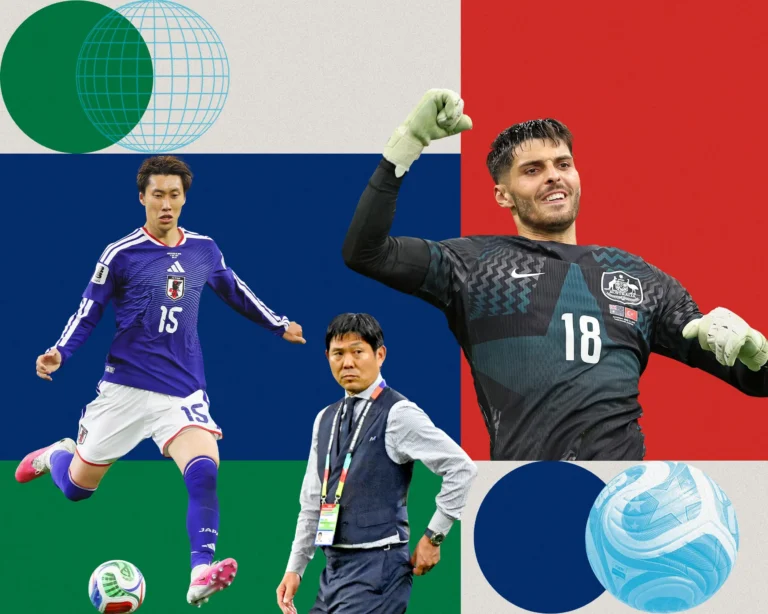
Daichi Kamada’s late equalizer for Japan against the Netherlands on Sunday not only adjusted the scoreline to better reflect the match but also marked a significant milestone: Asian teams have now gone unbeaten in their last four encounters against European teams in this tournament. While drawing sweeping conclusions from the early stages of a World Cup is premature, this trend could signal a shift in the balance of power in the world of football.
The tone for this potential shift was established on the tournament’s opening day with South Korea’s victory over the Czech Republic. Those familiar with South Korea’s qualifying playoff against Ireland might not have been surprised by the Czech side’s sluggish performance. They exhibited a reliance on set pieces and long throws, yet South Korea’s ability to maneuver around them was impressive. Had Son Heung-min been in peak form from a few years ago, the victory would have likely been even more convincing.
Australia’s triumph over Turkey further showcased the capabilities of AFC teams. Despite Turkey’s arduous path to qualification, marked by narrow 1-0 victories over Romania and Kosovo, they did not seem to pose much of a threat to Australia. Although Turkey registered 30 shots during the match, they encountered an outstanding performance from goalkeeper Patrick Beach, who made eight crucial saves. Australia’s tactical approach proved effective, demonstrating that their win was more than merely opportunistic.
Qatar’s draw with Switzerland, however, was less about strategy and more about survival. They adopted a defensive stance, seemingly satisfied to limit the score, but were fortunate that Switzerland squandered numerous chances. The lone goal for Switzerland, a penalty by Breel Embolo, was mired in controversy due to a malfunction of the semi-automated offside technology. Qatar secured a point thanks to an injury-time own goal from Miro Muheim, but their performance did not suggest any superiority over their European rivals.
The match that captured the most interest was the draw between Japan and the Netherlands. Despite missing three key players—Kaoru Mitoma, Wataru Endo, and Takumi Minamino—Japan demonstrated their potential. Two significant matchups in this World Cup, Brazil versus Morocco and the Netherlands against Japan, both ended in draws, with the emerging teams appearing to edge the contests. In both instances, teams typically associated with a less dominant style showcased the fluidity and precision often linked to their opponents.
Morocco exhibited a confidence and flair in possession, while Japan’s positional interchanges and purposeful attacks, despite holding only 40% of the ball, mirrored the Dutch style at their best. Notably, there was a palpable absence of inferiority from the Japanese squad.
Japan’s coach, Hajime Moriyasu, has recently emphasized the importance of overcoming psychological barriers that have historically hindered their progress past the last 16. He has framed his team as potential champions, a strategy that may serve to motivate his players to surpass previous limits. If the Netherlands are indeed contenders, Moriyasu seems to ask, why shouldn’t Japan be viewed similarly?
Keito Nakamura, who netted the first goal, and defender Hiroki Ito each achieved a 90% pass accuracy, highlighting their effectiveness. Kamada’s performance in midfield was characterized by aggression and intelligence, while Junya Ito provided a creative spark off the bench. There are high expectations for 23-year-old Zion Suzuki, who many predict could become Japan’s finest goalkeeper. If there was any disappointment, it stemmed from center-forward Ayase Ueda, who found it challenging to make an impact, though his previous season at Feyenoord showcased his potential.
Historically, AFC teams have struggled with self-belief when facing UEFA sides, but that narrative appears to be changing. Japan celebrated their equalizer with the fervor typical of a side that has snatched a draw, but the visible disappointment in conceding first was telling. The rankings of the groups indicate a significant evolution: Japan and Morocco no longer seem like easier opponents compared to traditional powers like Brazil and the Netherlands.
While four matches provide insufficient evidence for sweeping assertions, it is becoming increasingly clear that the top Asian teams are narrowing the gap with their European counterparts.
- This article is part of Soccer Desk: World Cup edition, a newsletter that will be published regularly during the tournament. Subscribe for free here.