


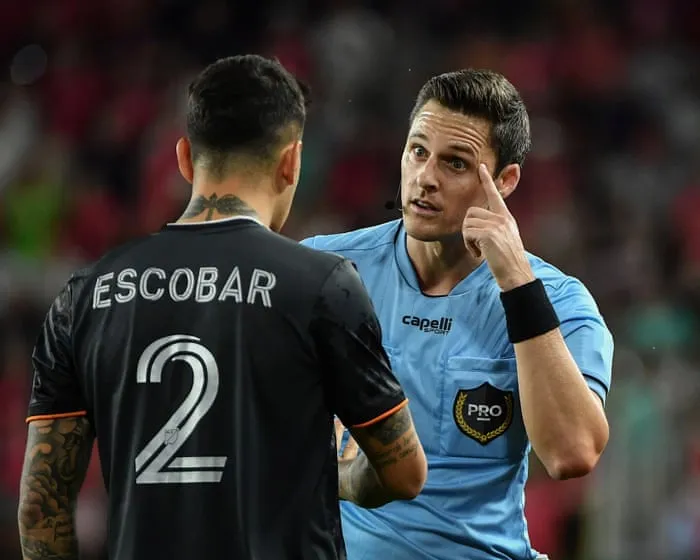
Joe Dickerson never aimed to become a referee. Initially a player, he was encouraged to take up officiating as a means to earn extra income, cultivate responsibility, and gain a deeper understanding of the sport’s nuances.
His early experiences in the San Jose region have blossomed into a rewarding career, culminating in his recognition as US Soccer’s male referee of the year in 2025. This achievement reflects his meticulous attention to detail, a skill he will rely on heavily as he takes on the role of VAR official during this summer’s World Cup.
“At one point in my journey, and this feeling persists, I dread approaching the monitor,” Dickerson shared. “It signifies that I may have erred, and I strive for perfection on the field.”
Gradually, Dickerson has adapted to this aspect of officiating, learning not to fear the monitor but to accept it. This acceptance will be crucial as he engages with it frequently from the VAR booth at various North American stadiums this summer.
The Role of VAR in the World Cup
As one of the many officials being evaluated by FIFA throughout the World Cup cycle, Dickerson was considered for both on-field officiating and video assistant roles during the tournament. He will serve as an auditory guide to the referee, alerting them to contentious plays that require review. His initial hesitance towards the monitor is expected to aid him in establishing the right tone when suggesting a second examination of a play to the on-field official.
“Most errors made during a World Cup by the world’s elite referees are minor,” Dickerson explained. “Perhaps ‘minor’ is misleading; they are, in fact, quite challenging. They are subtle and specific, often difficult to detect. These are the instances that rarely draw criticism towards referees.”
Academic Pursuits and Philosophical Connections
Beyond his officiating duties, Dickerson is pursuing a master’s degree at the University of Chicago. His thesis focuses on Machiavelli’s political philosophy, with a particular case study examining its connection to officiating. While this subject may seem unusual, he sees clear links from his perspective.
“In essence, I believe Machiavelli advocates for empathy and leadership through his hidden teachings, despite his largely amoral approach,” Dickerson noted. “I also have a deep appreciation for Nietzsche and Confucius. The reason I mention this is that many lessons learned in refereeing carry philosophical weight and can be applied to various life situations.”
Indeed, VAR has sparked philosophical debates within soccer communities almost since its inception. Recently, criticisms have intensified, particularly as contentious moments have influenced title races and relegation battles. In February, UEFA’s refereeing director cautioned that the review process was becoming “excessively detailed.” By the conclusion of the European club season, the Premier League decided against expanding VAR’s authority to include potential corner kicks, a topic set for examination during this World Cup at FIFA’s behest.
World Cup Unique Challenges
Dickerson perceives the differences between international and club football as beneficial for referees during this World Cup. In a league format, numerous matches spread across months can make any anomalies focal points of contention.
“All FIFA events, particularly the World Cups, are distinctive because they are tournaments,” Dickerson stated. “They are highly visible and condensed timeframes.”
Now, a decade into the VAR era, the most debated calls often involve handballs, instances where one player gains possession before contact with an opponent, and situations where players seek to draw fouls by initiating contact. These scenarios are closely scrutinized during referee seminars, with the latest gathering held in Brazil.
“We participate in a 10-day seminar to ensure we maintain as much consistency as possible in our decisions,” Dickerson elaborated. “We understand that the vast majority of decisions at the World Cup will be clear-cut, even if the general public may not see it that way. We have dedicated substantial time analyzing these clips, allowing us to confidently identify a handball, a penalty, a red card, or a yellow card.”
Currently, VAR booth operations consist of a trio of officials: the video assistant referee, who communicates with the on-field referee throughout the match; a support VAR who monitors the game while the VAR reviews a specific call; and an assistant VAR who takes notes that the VAR cannot jot down during the review. Each member of this team has received identical training, enabling them to consider potential reviews collectively.
Embracing the Controversy of VAR
While opinions on video review may vary, and even the center official may not favor it, it is anticipated that VAR will play a significant role during this World Cup.
“One cannot eliminate the public’s bias from any VAR analysis,” Dickerson remarked, “and that’s not necessarily negative. I enjoy officiating in what I would consider hostile stadiums because it shows the fans are deeply passionate about the game. That’s one of the sport’s many charms.
“Another wonderful aspect is the subjectivity involved. When subjectivity combines with inherent bias and intense emotions, it leads to a myriad of strong opinions regarding VAR decisions.”