


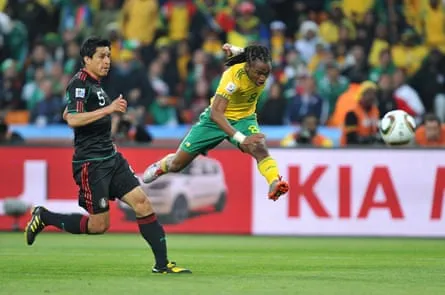
The 2026 World Cup kicks off with a highly anticipated match between Mexico and South Africa, echoing their first encounter during the 2010 tournament. As noted by Matt Reilly, this raises an intriguing question: is this the first time that the same two teams have faced off in the opening match of a World Cup, or is there a history of repeated fixtures?
In the inaugural game of the 2010 World Cup, the host nation South Africa met Mexico, resulting in a thrilling 1-1 draw. Siphiwe Tshabalala opened the scoring with an impressive strike, only for Rafael Márquez to equalize in the 79th minute. Their rematch is set to take place at the iconic Azteca Stadium this Thursday.
Interestingly, a similar opening fixture has occurred before, with Mexico involved once again. Historically, the World Cups of yesteryears often commenced with multiple simultaneous matches. In 1934, for example, all 16 teams kicked off at the same time: 4 PM CET on May 27.
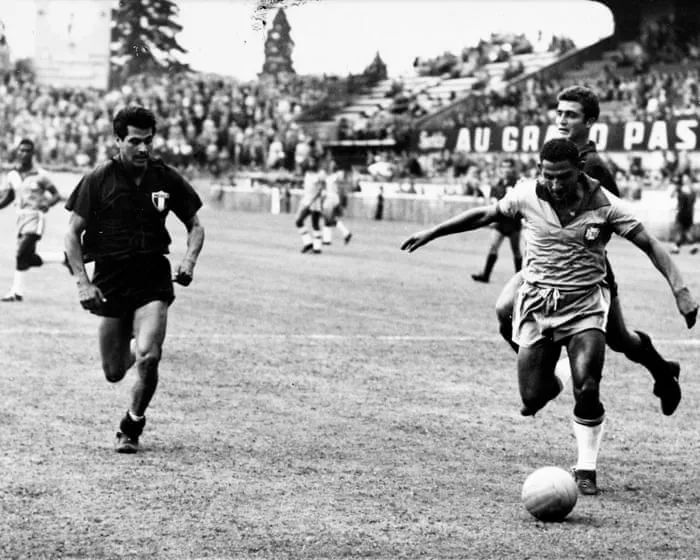
The last instance of simultaneous opening fixtures happened in 1962 in Chile, a format that increases the likelihood of repeated matchups. Between 1950 and 1962, Brazil faced Mexico three times in four tournaments.
In the 1950 World Cup held in Brazil, the opening game was a standalone event, while in the following tournaments of 1954 and 1962, it was part of a quartet of matches. Brazil triumphed each time, with a notable 2-0 victory in 1962 that featured a memorable solo goal from Pelé.
- 1950: Brazil 4-0 Mexico – Goals from Ademir (2), Jair, and Baltazar
- 1954: Brazil 5-0 Mexico – Scorers Baltazar, Didi, Pinga (2), and Julinho
- 1962: Brazil 2-0 Mexico – Goals by Zagallo and Pelé
During the 2014 World Cup in Brazil, Mexico found itself in the same group as the hosts, which could have set the stage for an opening game. However, Brazil began their campaign with a 3-1 victory against Croatia before securing a 0-0 draw with Mexico in their second match.
Meanwhile, since its inception in 1991, the Women’s World Cup has only had a single opening fixture, and none have ever been repeated.
Peter Chamberlain posed an interesting question regarding the absence of Real Madrid players in Spain’s World Cup squad this year. This marks a significant first, as although there are ten players from Real Madrid present at the tournament, none will represent the Spanish national team. Previously, the lowest number of Madrid players was recorded in 1950, with Luis Molowny being the sole representative who played just one game against the eventual champions, Uruguay.
Interestingly, Spain’s women’s team, founded in 2014, also lacked Madrid players in the 2015 and 2019 World Cups. By 2023, however, the team boasted eight players, including Olga Carmona, who scored the decisive goal in the final.
Former Everton Managers Take Center Stage
Mike Hulse raised a query about the presence of three former Everton managers at the World Cup, specifically Carlo Ancelotti (Brazil), Roberto Martínez (Portugal), and Ronald Koeman (Netherlands). He wondered if this constituted a record.
While it’s a noteworthy observation, this isn’t a tournament record. Matthew Williams pointed out that four former Chelsea managers will also be coaching teams in the coming weeks:
- Carlo Ancelotti (Brazil)
- Mauricio Pochettino (USA)
- Graham Potter (Sweden)
- Thomas Tuchel (England)
Moreover, Matthew highlighted that Scotland has a former Chelsea assistant coach in Steve Clarke.
Exploring the Knowledge Archive
Paul Wilson inquired about Tommy Smith’s inclusion in New Zealand’s World Cup squad, noting his previous play for Braintree Town in the fifth-tier National League. He asked if a player from a lower division had ever been called up to a World Cup or continental championship.
This question surfaced four years ago when the best examples cited were from the 2006 World Cup, particularly within the squads of Togo and Trinidad and Tobago. Leigh Cartwright noted that “in 2006, they took Dennis Lawrence, who was playing at fourth-tier Wrexham, and Evans Wise, who was playing in Germany’s fifth tier for Waldhof Mannheim.”
“Brent Sancho, Ian Cox, and Chris Birchall were also selected from League One (Gillingham, Gillingham, and Port Vale, respectively),” Cartwright added.
“During the same tournament, three Togolese players represented clubs on the lower tiers of French football,” Chai in Atalanta remarked. “Affo Erassa played for AS Moulins (tier three), Alaixys Romao played for Louhans-Cuiseaux (tier three) and Richmond Forson played for amateur club Vendée Poiré sur Vie in Régional 1 (tier seven).”
Florian Camphausen shared a bit of trivia regarding Sherif Touré Coubageat, who played briefly for Togo in the 2006 Africa Cup of Nations but was not called up for the World Cup.
Calls for Assistance
Kári Tulinius posed an intriguing question about Thomas Hässler, who won the World Cup in 1990 and the European Championship in 1996. With only one trophy from his club career, he wonders if anyone has exceeded his international honors by two or more.
Brendon O’Mahony pointed out that in 1986, Gary Lineker netted six of England’s seven World Cup goals. He inquired whether anyone had scored a higher percentage of their country’s goals at a World Cup, excluding teams eliminated in the group stage or those scoring three goals or fewer.
Stuart McLagan raised a question about Scotland’s 2026 squad, which features no more than three players from any single team. He wondered if this was the lowest number for any World Cup, along with the record of 21 different clubs represented in the Scottish squad.
Additionally, he recalled the unusual case of El Salvador’s team in the 1982 World Cup, who opted to take only 20 players instead of the allowed 22, citing cost-saving measures. He pondered if this was the most recent instance of squads being short-handed.