


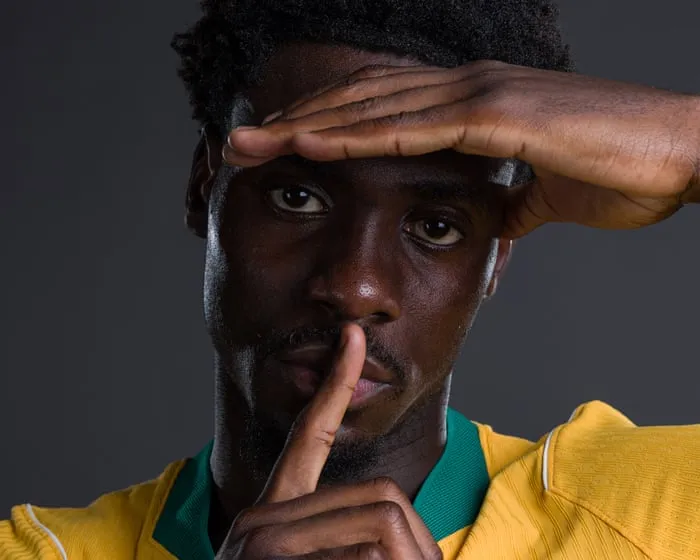
The 22-year-old striker recently expressed his surprise but satisfaction upon discovering a humorous graphic circulating on social media. The image, which featured the phrase, “Mohamed Touré is … The Ter-Mo-Nator,” depicted Touré with his left eye glowing red and the caption reading, “Target acquired.”
Touré, affectionately known as Mo, has ignited excitement among Australian football fans reminiscent of the enthusiasm generated by Mark Viduka nearly four decades ago, who made his mark at Melbourne Knights. As a prominent figure in the Socceroos’ current World Cup journey, the rising star is gradually acclimating to the attention.
However, the Arnold Schwarzenegger comparison is a fresh twist. “Some may have likened me to certain characteristics like being serious or playing hard, but being called a Terminator is a first,” Touré shared from his training base in California, where he is preparing for the opening match against Turkey on Sunday.
When asked if he embodies the relentless machine from the original film or the hero who protects John Connor in the sequel, Touré chuckles, saying, “No, I’m the friendly one. I can’t be evil.”
Throughout the conversation, a recurring theme emerges: Touré’s inclination toward positivity and goodness. When queried about how he wishes to be introduced to Australians re-engaging with football after a four-year hiatus, his response is immediate. “Some individuals aspire to be superstars,” he notes. “I simply want to be recognized as a good person.”
Strikers often carry a reputation for self-interest and basking in the limelight, prioritizing personal accolades over team accomplishments. While Touré possesses the attributes of a classic forward, including speed, finesse, and skill, he distinguishes himself by being an integral part of Tony Popovic’s cohesive strategy, aimed at outsmarting their Group D rivals.
Having been born in a refugee camp in Guinea after his parents fled Liberia, Touré arrived in Australia when he was just seven months old. His parents spent 14 years in that camp. “I have a story that existed before football and one that follows it,” Touré reflects.
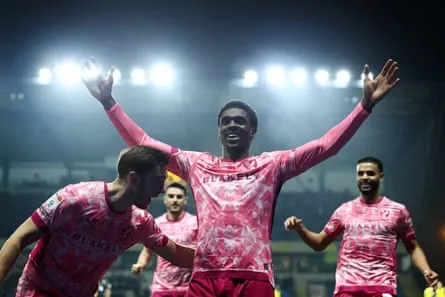
The narrative of his football career took off in Adelaide, where he made his A-League Men debut at the age of 15 in 2020, becoming the league’s youngest scorer. He later debuted in Ligue 1 for Reims at 19, made headlines with a double against Brøndby while playing for Randers FC in the Danish Superliga in 2024, and netted two goals for the Socceroos against New Zealand in late 2025. After transferring in January, he scored nine goals in 11 league games for Norwich in the Championship last season.
Nevertheless, Touré’s journey has not been a straightforward ascent. He has faced numerous injuries and has changed clubs five times in four years. The injury struggle has shadowed him since his tenure at Adelaide United, where balancing his explosive speed, a growth spurt, and the demands of professional football proved to be a challenge more complex than his moral compass.
“When I transitioned to Europe, some of those injuries accompanied me, and I kept re-injuring them,” he admits. “I felt the need to make adjustments; otherwise, they would persist.”
Now, Touré follows a comprehensive regimen aimed at building resilience. “I focus on strengthening areas to avoid those pesky injuries during the season,” he explains. “The major muscle groups include the hamstrings, groin, and quads.”
His recovery is a significant advantage for the Socceroos. He played 81 minutes in a warm-up match against Mexico, and while he and several starters were benched against Switzerland on Sunday, he was brought on for the final 20 minutes.
Touré is one of six African Australians on the 26-player roster, including Awer Mabil, Lucas Herrington, Tete Yengi, and Jason Geria. His closest bond is with Nestory Irankunda; their friendship blossomed through football during their school years in Adelaide. Irankunda, like Touré, is a refugee, with his family from Burundi via a camp in Tanzania, situated on the continent’s opposite side.
“We come from different backgrounds, but especially in Adelaide—other cities might differ—we don’t perceive those distinctions; we simply see ourselves as part of a large African community. Naturally, within that community, there are various sub-communities, yet to me, Nestor is just another African boy, and Mabil is just another African guy. We all share a love for the same sport, which unites us,” he elaborates.
Liberia may not be participating in this World Cup, but their diaspora is represented. Haji Wright, a striker for the USA, scored twice against the Socceroos in a friendly last year, and Timothy Weah, the son of George Weah—the only African Ballon d’Or winner and Liberia’s former president—also plays for the host nation.
Touré’s father, Amara, keeps him informed about developments in Liberia, and the young athlete maintains a strong connection to his parents’ homeland. “Oh man, it will always feel like home when I hear the word Liberia,” he affirms. “It’s where I feel I belong, and no matter how difficult it becomes, I will never abandon it or cease caring for it.” He also expresses affection for Guinea and “obviously” for Australia.
Touré deeply respects the Socceroos who paved the way for him. For many years, Australia’s male footballers struggled as near-misses, unable to secure a World Cup spot. However, Touré and his peers have known only success in qualifying.
When John Aloisi scored the decisive penalty that secured Australia’s place in the 2006 World Cup, Touré was just a year old. He was barely walking when Viduka led the team onto the pitch for the iconic victory over Japan in Kaiserslautern, which occurred 20 years ago this month.
“We were just discussing it at dinner because we have pictures of all the past teams and lineups on our dining room wall, trying to identify how many players we recognized,” he shared. “We discussed where they played… it was amazing, truly delightful.”
Conversations about Harry Kewell’s time at Liverpool, Tim Cahill’s contributions at Everton, and the journeys of Vince Grella and Mark Bresciano in Serie A invigorated ambition within the younger group. Historically, Australia’s finest footballers have rarely reached the pinnacle of the sport at major European clubs.
“We were stating that at our table, where many young boys sit, that’s our aspiration as well for the future. We want people to look at our squad and say, ‘Oh, that’s Mo from Real Madrid, that’s Nestor from Bayern, that’s Lucas from Liverpool.’”
Since Aloisi’s and Viduka’s eras, Australia has yet to produce a complete striker thriving in a top European league. While Mitch Duke excelled in Qatar and hybrid winger Mathew Leckie has had standout moments, players like Jamie Maclaren, Tomi Juric, Nikita Rukavytsya, and Josh Kennedy have been more specialized roles: finishers, speedsters, or target men. Touré possesses the qualities of a top-tier forward: strength, agility, and skill. However, he immediately dismisses any comparisons to Viduka. “That’s absurd; it’s too much,” he responds.
The recurring motif in the Terminator films is the quest to reshape the past to secure a better future. Observers have commented on the youthful nature of this Socceroos squad, featuring Touré, Irankunda, full-back Jordy Bos, and central defenders Herrington and Alessandro Circati. Speculation abounds that this team may improve significantly by 2030 or 2034.
Touré remains grounded and does not take opportunities for granted. Despite his youth, he understands that the narrative of football cannot be rewritten. “Playing for the Socceroos has always been a dream of mine,” he admits. “Now that I’m here, I don’t have forever. The boys often say that representing the national team comes quickly, so I aim to make a lasting impact.”