


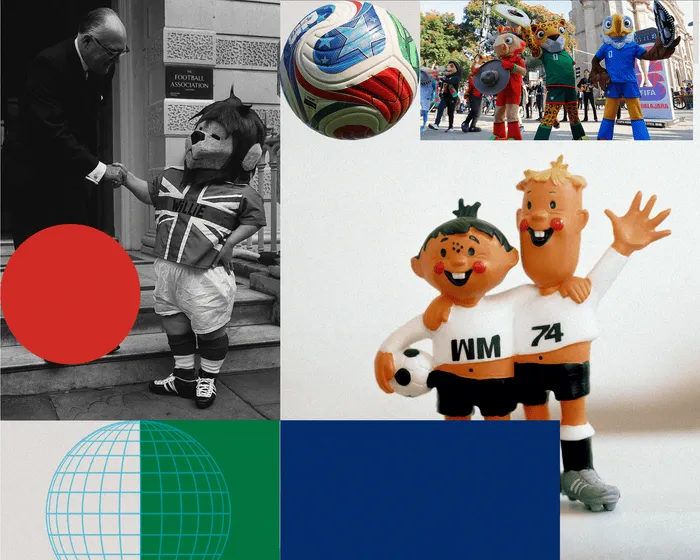
World Cup Willie burst onto the scene in 1966, sporting a distinctive spiky mane, a bold stance reminiscent of a bovver boy, and oversized shoes, all topped off with a Union Jack shirt—a curious choice for a tournament hosted entirely in England. Created by children’s illustrator Reg Hoye in just five minutes, Willie would go on to become a marketing phenomenon, appearing on an array of merchandise from bed linens to beer mats, and ceramics to breakfast cereals.
Fast forward sixty years, and it’s evident that the charm of World Cup mascots has considerably dwindled since their heyday in the 1970s and 80s. As we look ahead to 2026, we are met with a parade of uninspired, corporate anthropomorphic animals, including the Canadian moose Maple, the Mexican jaguar Zayu, and the American bald eagle Clutch—characters that feel more like cast-offs from a low-budget animated sequel.
According to FIFA’s website, Maple “combines endless stories and unstoppable flair,” which is not exactly what one hopes for from a moose guarding the goal. His antlers might deter some players from challenging him in the box, but the description leaves much to be desired. Meanwhile, Clutch is said to “unite people wherever he goes,” a notion that prompts a chuckle, especially for fans of Roy Keane.
While some might argue that only the intended audience should critique Maple, Zayu, and Clutch, it’s worth noting that Willie was not solely designed with children in mind. The merchandise from 1966 also included branded Wee Willie Cigars, car ornaments, and lighters, showcasing a broader appeal. It’s also misleading to claim that every mascot following Willie was an unqualified success. Take Juanito from the 1970 Mexico tournament—his design as a boy in a sombrero was rather uninspired. In contrast, the 1974 World Cup introduced the delightful duo Tip and Tap from West Germany, whose big man/little man dynamic sounds like a tactical plan straight from Pep Guardiola’s playbook. Was Pep’s football philosophy partially influenced by them at age three? It’s impossible to confirm, but one might be tempted to say yes.
Argentina’s 1978 entry, Gauchito, captivated audiences with his cheeky grin, whip in hand, and confident demeanor—traits typical of a player ready to nutmeg a defender (let’s hope we never see a World Cup mascot wielding a whip again). Then there was Naranjito in 1982, a giant orange crafted by graphic artists José María Martín Pacheco and Mariano Sedano, who drew inspiration from their home city of Seville.
Naranjito serves as a prime example of how a straightforward concept, executed well, can achieve immense popularity. The character was so beloved that he starred in his own animated series, Fútbol en Acción, alongside his friends Clementina (a mandarin), Citronio (a hapless lemon), and Imarchi (a robot, just for fun!). Football legend Alfredo Di Stéfano even made appearances, offering skill tips to young viewers.
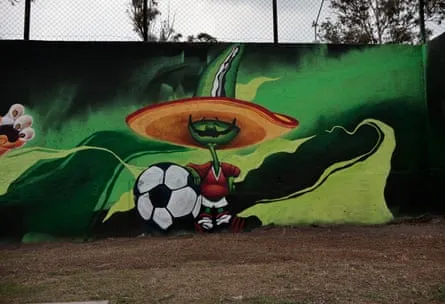
However, while Naranjito enjoyed international acclaim, 1986’s Pique stirred controversy in Mexico. This green chili pepper adorned with a sombrero and a lengthy mustache was deemed to rely too heavily on national stereotypes. A government official remarked, “It has nothing to do with the Mexico of today,” criticizing the portrayal as an outdated caricature. One of Pique’s creators, Segundo Pérez, attempted to defend the design, likening it to “a sleepy Indian taking a siesta against a tree,” a comparison that perhaps did not quell the criticism.
In 1990, Ciao made a distinct departure from stereotypes, resembling a nightmarish Italian stick figure. Even FIFA’s own website admits this mascot is not “traditionally cuddly,” describing Ciao endearingly as “the first and, to date, only mascot without a face.” Lucio Boscardin, who conceived this angular, football-headed character while waiting at a traffic light, surely did not anticipate the reaction it would evoke.
Following Ciao, the quality of mascots began to decline. The 1994 World Cup in the US marked a significant downturn, with Striker—a dog mascot created merely because pets are popular in America. Striker lacked redeeming qualities, setting a disheartening precedent for future mascots.
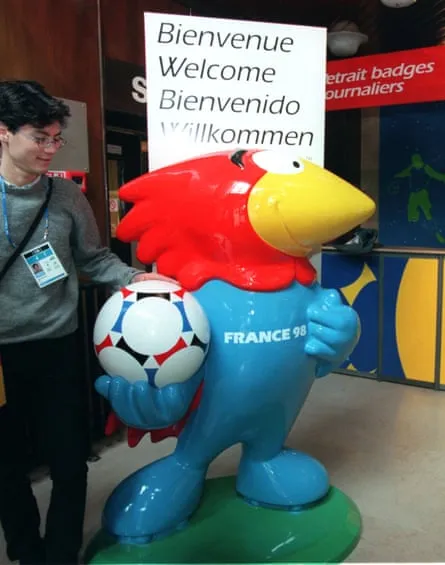
Footix, the large blue rooster from France 1998, managed to maintain some charm thanks to his appealing design. Notably, he became the first World Cup mascot to have offspring, as his daughter Ettie represented the Women’s World Cup in 2019. Unfortunately, the 2002 Japan and South Korea tournament introduced a trio of aliens that were disappointingly dull. Ato, Kaz, and Nik, named through a McDonald’s voting campaign, resembled toys you would regret finding in a Kinder Egg.
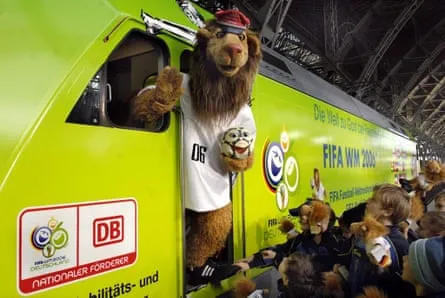
The 2006 World Cup saw the last genuine attempt at creativity with Goleo VI, a lion, and his talking ball named Pille. Despite being designed by the renowned Jim Henson workshop, this pair failed to resonate, with Goleo VI’s unsettlingly realistic appearance and lack of trousers inciting public disapproval. Their unpopularity led to the collapse of the Bavarian toy company that had secured their merchandising rights even before the tournament commenced.
A string of uninspired animal mascots followed: Zakumi the leopard for South Africa 2010, Fuleco the armadillo for Brazil 2014, and Zabivaka the wolf for Russia 2018, whose ski goggles lent him an odd Winter Olympics vibe. There was a glimmer of hope with Qatar 2022’s La’eeb, showcasing a traditional Arab headdress—a more imaginative choice than yet another local creature, though the design had a strangely ghostly appearance.
This brings us to the current uninspired trio. With the prospect of new mascots for Morocco, Portugal, and Spain in 2030, it seems unlikely that a resurgence is on the horizon. The era of unique and endearingly eccentric World Cup mascots has long since vanished, much like one of Willie’s World Cup cigars.