


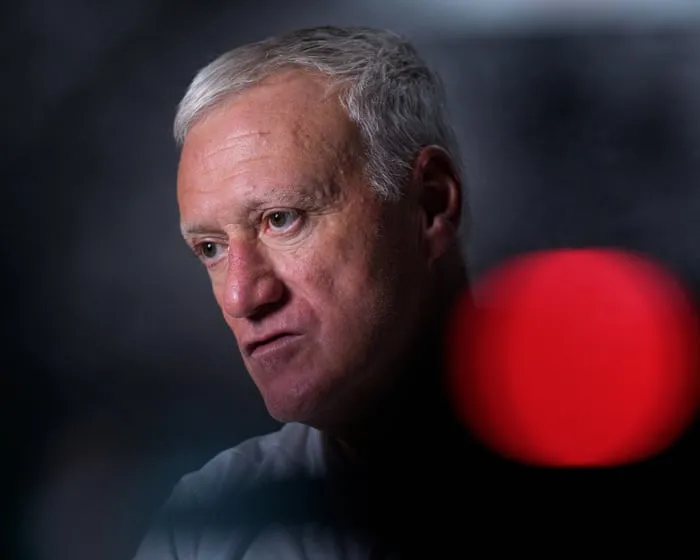
As you stroll along the lush pathway leading to the Château de Clairefontaine, a striking three-meter replica of the World Cup trophy greets you, flanked by two stars symbolizing France’s victories in the tournament. Didier Deschamps played a pivotal role in both triumphs, first as captain in 1998 and then as manager in 2018.
The 1998 World Cup marked France’s inaugural championship, but the team has since appeared in four of the last seven finals, with Deschamps participating in three. As the tournament approaches in North America, he faces another opportunity to add to this legacy. The expectations are high, shaped by a history of success. Deschamps has led France to three major finals throughout his 14-year tenure as manager. “We’re among the favourites,” he states as we begin our conversation. “I don’t shy away from that term. If we have this status today, which I find logical and justified, it’s due to our past accomplishments and the results we’ve achieved.”
During our discussion, his assistant, Guy Stéphan, pokes his head into the room, quipping, “You’ve got the best.” Deschamps chuckles in response, “He’s always so objective.” It’s hard to argue against Stéphan’s comment when considering Deschamps’ remarkable track record both as a player and a coach.
Nevertheless, there exists a subjective element. “Internationally, there may be more recognition,” Deschamps observes. “I am well aware, having traveled extensively, that perceptions abroad differ from those in France.” Many within the country question the team’s style of play. Before addressing this, he lets out a light laugh: “What do you mean by ‘play style’? On the international stage, that’s one thing, but in France, it’s another. Despite being labeled as a [team with a] defensive, cautious approach, we’ve still managed to achieve results.”
Deschamps, however, shows little concern for his legacy. He insists that “it doesn’t matter” and expresses no interest in it. “What truly matters is today and tomorrow, with tomorrow being the World Cup. After that, everyone will form their own … interpretations, their own feelings.”
While public perception holds significance, how he is viewed by his peers is equally important. Gareth Southgate once looked up to him, and Deschamps mentions having exchanged messages with Thomas Tuchel, “a very good manager whom I admire greatly, and with whom I enjoy conversing,” as well as Brazil’s Carlo Ancelotti and former Germany coach Hansi Flick. His accomplishments, including three major finals and a Nations League title, have solidified Deschamps as a titan of modern international football.
He asserts, however, that there is no secret recipe to replicate. “I have a key principle: adaptation … I tell myself, ‘Based on the person I’m dealing with, I adapt.’ This leads to adjustments … Just because something worked before doesn’t mean we shouldn’t change. But it’s not about changing for change’s sake either,” he explains.
Beyond tactics, effective man management also requires adaptability. “The generation I began with in 2012 is not the same as today … the new generation needs more communication,” Deschamps states, having overseen a significant transition in the France squad.
Following the 2022 World Cup final loss to Argentina, several key players, including Hugo Lloris, Olivier Giroud, Raphaël Varane, and Antoine Griezmann, announced their retirement from international duty. “The baton has been passed,” Deschamps remarks, naming Kylian Mbappé as the successor to Lloris, France’s most-capped player.
“Kylian, our current captain, before taking on this role, observed and learned; he doesn’t emulate Hugo. They have entirely different personalities and characters. He demonstrates leadership both on and off the pitch, and he understands that when he speaks, he represents not just himself but all the players.” Deschamps also defended his deployment of the Real Madrid forward, stating, “I must be foolish, and there must have been many foolish coaches before me to place him in the center of attack over the teams he’s been part of … for the last two years at Real and his final year at PSG … he has played centrally for three years.”
Mbappé’s performance at Euro 2024 fell short of expectations. His broken nose sustained in the opening match against Austria certainly hampered his efforts, and Deschamps noted that his preparation for the tournament was “suboptimal,” adding, “He arrived after a very challenging final six months at PSG, during which he had limited playing time.” Heading into this World Cup, Mbappé is just one goal away from surpassing Giroud’s all-time scoring record for France (57), which serves as a validation for Deschamps, whose selections are consistently scrutinized yet often prove to be astute.
For Mbappé to break Giroud’s record, Deschamps must strike the right “balance,” a term he emphasizes repeatedly throughout our rainy afternoon conversation. “At the 2022 World Cup, we already had four attackers [starting],” he counters the notion that a shift from a 4-3-3 to a 4-2-3-1 might compromise Les Bleus’ renowned defensive solidity.
He highlights Griezmann’s role, positioned within the midfield trio as the fourth attacker during the 2022 World Cup. His replacement in the squad is Michael Olise. “He’s a quieter individual, somewhat shy, but once he’s on the pitch, it’s a joy to watch,” Deschamps praises. “Today, he’s someone who shines, and he’s among the best players at the World Cup.”
Deschamps faces tough choices, particularly concerning the forward positions. Players like Mbappé, Olise, Ousmane Dembélé, Rayan Cherki, Désiré Doué, Bradley Barcola, Marcus Thuram, Jean-Philippe Mateta, and Maghnes Akliouche cannot all feature simultaneously.
“It’s about managing the disappointment of those who won’t be in the starting lineup,” Deschamps reflects. “It’s always challenging to accept, as each player believes he’s superior to the one occupying his position … ask any professional footballer at the top level, and they will say: ‘Competition? Of course, it’s part of our lives,’ but when it involves themselves, it becomes more complicated.”
Consequently, and in line with Tuchel’s observations, Deschamps stresses that it’s not merely about selecting the best 26 players for the World Cup.
As he approaches his 58th birthday in October, Deschamps is well aware of these dynamics. He describes international management as a “totally different role” from club management, emphasizing that none of his World Cup peers possess the extensive experience he has gained.
“If I remain in this position today, it’s because the French team has won numerous matches. Otherwise, my tenure could have ended earlier, whether by my decision or otherwise,” he states. Ultimately, it was his choice. As he confirmed in January 2025, Deschamps will step down following Les Bleus’ campaign this summer.
This isn’t retirement, but the former Juventus, Monaco, and Marseille manager is not contemplating what lies ahead. “I won’t make any decisions until after [the World Cup],” he reveals, although he acknowledges that there have been offers.
When asked about the possibility of taking a break, Deschamps states he has “the freedom to choose.” That wasn’t the case the last time he took an extended hiatus from the sport. “I took a break at Juventus in 2007. Between 2007 and 2009, I was on practically every shortlist. However, my son told me: ‘The issue is that you always come up short.’” He doesn’t necessarily need the World Cup to showcase his value.
While Deschamps may not focus on legacy, as he exited the Château de Clairefontaine for the final time this past Sunday, he has undeniably crafted one.